Nancy Spencer is a professor emerita who taught in the Sport Management program at BGSU for 25 years. Her focus was and continues to be on women’s professional tennis.
July 11, 2025
How unusual is this?
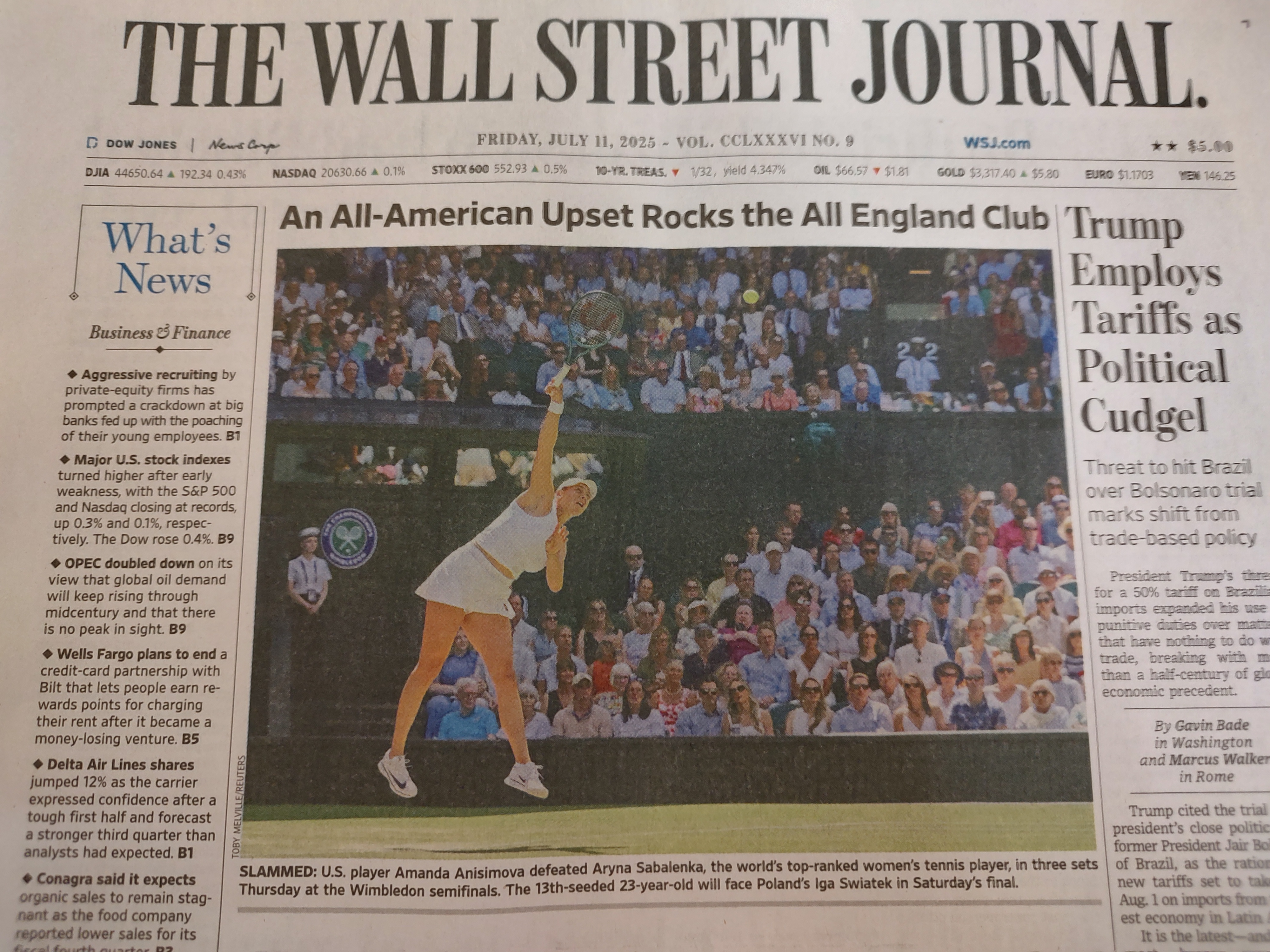
I usually don’t buy the Wall St. Journal but this one caught my attention because of the photo featured front and center!
The caption read: “An All-American Upset Rocks the All England Club“
So I put down $5.00 to buy it, in anticipation of reading an accompanying article that might explain why Amanda Anisimova appeared on the cover!
Only, there was no article attached, unless I had a subscription, so I paid for a 1-year subscription (at a reduced rate). There was another article about Billie Jean King’s transformation of women’s tennis (Bobrow, 2021), so I reasoned it would be worth the investment. After all, isn’t the Wall St. Journal about investments?
I wanted to discover what made Amanda Anisimova’s story compelling enough to feature on the front page of the WSJ. If you follow tennis, and/or watched the semifinal match that she played against Sabalenka (the No. 1 player in the world), you know that two years ago Anisimova took a break from tennis due to burnout. Joshua Robinson (2025) called her “a textbook case of the American tennis phenom who burned out” (para. 1).
Similar to other young phenoms, Anisimova rose quickly to the pinnacle of junior tennis, winning the Girl’s U.S. Open at age 16 (defeating another up-and-comer named Coco Gauff), and she reached a grand slam semifinal before turning 18. That would have been enough pressure, but then her father passed away and that “only deepened her doubts about life in pro tennis” (Robinson, 2025, para. 2).
Two years is a long time to be away from any professional sport and Anisimova had her detractors who warned that she could never come back at a high level if she stayed away too long. But she listened to what her body and mind were telling her and she is now in the midst of a dramatic return. It hasn’t all been positive. A year ago, she ranked outside the top 400 and had to play in the qualifiers at Wimbledon. She did not even make it to the main draw. But since then, she has made improvements to her game as the results are now showing.
Anisimova’s story is not just about her triumphant moment, but about the growing presence of U.S. women among the top-ranking professional women tennis players. American women occupy 4 of the top 10 rankings, including: Coco Gauff (#2), Jessica Pegula (#3), Madison Keys (#8), and Emma Navarro (#10). Anisimova is currently ranked #12 but could climb to as high as #5 if she beats Iga Swiatek in the final.
In tomorrow’s final, Anisimova will face a player she has never played, Iga Swiatek, winner of 5 grand slam titles. Her most recent title came in 2024 when she won her fourth French Open title; this will be her first Wimbledon final. Swiatek has several things in her favor – experience (she spent 122 weeks at No. 1), and she has won all five finals that she reached. If she wins tomorrow, it will be her 100th match victory at a grand slam tournament. So far at Wimbledon, she “has won 78% of her first-serve points,” which should give her confidence going into the final (Garber, 2025, para. 16).
On the other hand, Anisimova has momentum after beating the current No. 1 player in the world. Her break from tennis has given her a renewed optimism and appreciation of playing tennis at such a high level. And there is this – she has 28 straight match victories when she won the first set (Garber, 2025).
Whatever happens in tomorrow’s final, there will be a newly-crowned champion. Based on experience, I have to give it to Swiatek, but given Anisimova’s momentum, I cannot rule her out. That is a match I do not want to miss! Hopefully, you get to see it too!
Brady Shick is from Sagamore Hills, Ohio and recently graduated from Bowling Green State University. He is currently seeking opportunities to pursue a career in Baseball Operations.
July 7, 2025
Every team in Major League Baseball (MLB) looks for a way to get a foot up on their competitors. In past drafts, teams have taken high school prospects higher than they are projected and try to sign them away, with more money than projected, from the college for which they committed to play. One of the most common ways and most controversial is through service time manipulation. Service time is a value system that equates the number of days a player spends on the active 26-man roster for each Major League team. Service time is then used to determine when a player reaches arbitration with his respective club. Small market teams are normally the main culprits of manipulating their players’ service time, but almost always headlined each season by the Pirates. The most common way to manipulate is through the Super-2 deadline and the debuts of top prospects.
The Super-2 deadline normally takes place in the end of May or beginning of June every year and is the cutoff date for players to gain an extra year in which they are arbitration eligible, which normally takes place after three years of service time. If a player is in the top 22% of service time compared to those in their rookie class, they gain an extra year where they can go to arbitration to make more money during that season. If teams wait to call up a prospect later they can save money to use in free agency.
Teams like the Pirates constantly use this strategy with examples being Gerrit Cole, Austin Meadows, Tyler Glasnow, and most recently Paul Skenes. Notable stars called up after the deadline include Bobby Witt Jr (Kansas City Royals), Byron Buxton (Minnesota Twins), Elly De La Cruz (Cincinnati Reds) among others. Most of these players eventually went on to free agency, signing with other teams or being traded prior to reaching free agency.
2025 and Super-2
Within the last week, Major League Baseball has seen two of their top minor league prospects come up to the big leagues in Jac Caglianone (Royals) and Roman Anthony (Red Sox). Caglianone, a former two-way player, hitting and pitching at the University of Florida, has dominated across both AA and AAA levels in the minors. This was all while learning a new position (right field). Caglianone made his Major League Debut without playing a full season in the minors and after dominating in the lower levels.
On the other hand, Roman Anthony has been as dominant as anyone in the minors this season batting .288 with 10 homers in 58 games. He was also the top prospect in all of Minor League Baseball’s second visit to Triple-A. Many scouts across the industry were perplexed as to why he hadn’t gotten the call to the big leagues yet. Major League executives were less confused on his arrival time to Boston. By holding Anthony until this time of the season the Red Sox let the Super-2 deadline pass and gained an extra year of pre-arbitration control on Anthony. All of this was done for the Red Sox to save a few extra bucks while continuing to fall out of the division and wild card standings.
The Red Sox aren’t the only team following this practice. The second ranked prospect in the minors, Bubba Chandler (Pirates), is currently pitching in Indianapolis. The Pirates have called up three other pitching prospects from Triple-A all of whom were on staff with Chandler and none of whom have pitched as well as he has. This is just another instance of the utilization of the Super-2 deadline for baseball.
Dying Practice
Many fans will remember that the 2022 MLB season was delayed due to a players’ strike. One of the largest gripes by the Players Union was the service time manipulation by front offices across the league. Finally, after three plus months of a strike both the owners and players agreed on a new collective bargaining agreement with this issue somewhat resolved.
The solution was for owners and front offices to be incentivized to call up their top prospects at the beginning of the season. If a top prospect makes the Opening Day roster and then wins his league’s respective Rookie of the Year award, that team receives a pick after the first round in the next draft. A team will also receive an extra pick if that prospect finishes in the top three of the Cy Young or MVP awards before he reaches arbitration. However, a team is only eligible for one pick each draft and each player’s success can only be responsible for one extra pick. Since the inauguration of this rule, the Orioles and Mariners have benefitted with Adley Rutschman finishing second in the Rookie of the Year race in 2022 and Julio Rodriguez winning Rookie of the Year that same season.
This new system also can have negative consequences for front offices. Last year’s National League Rookie of the Year did not make the Opening Day Roster for the Pittsburgh Pirates. Had Skenes been up since day one, the Pirates would have received an extra pick in this month’s draft, but due to the new rules this wasn’t the case. Additionally, because Skenes won Rookie of the Year he was awarded a full-year of service time and the Pirates lost the extra year of pre-arbitration they were fighting to maintain.
Future of the Super-2
Service time manipulation has been a big issue for years within the MLBPA and it looks like a better solution is coming. Potentially, long gone are the days of prospects not making their debuts until early to mid-June thanks to the potential for an extra draft pick. However, baseball might be the hardest to predict a prospect’s future. There are plenty of guys that take a year or even a couple to figure out the big leagues. With so much uncertainty teams and front offices will continue to find ways to lengthen their competitive window and service time manipulation is the most accessible. But for the fans hopefully they can see a Travis Bazzana (Guardians) or a JJ Weatherholt (Cardinals) on an Opening Day roster.
Lily Smith is a second-year undergraduate at BGSU from Oregon, Ohio. She is majoring in Sport Management with a Marketing minor. In her spare time, she is an intern in the BGSU Athletics Marketing department, a BGSU Campus Tour Guide, and an avid reader. She is passionate about all things women’s sports, and all things women in sports.
Just about a month ago, I returned to campus from my trip to New Orleans for Super Bowl LIX. I went on the trip with 23 other members of the BGSU Sport Management Alliance (SMA). We travelled to New Orleans, Louisiana to work various different events surrounding Super Bowl LIX.
Super Bowl LIX logo in front of the Caesars Super Dome
Day 1: Travel Trauma
Our first day of the trip was mainly a travel day. Our flight to New Orleans had a short layover in Denver. Although we were only in the Denver airport for about 30 minutes, I still got to see the mountains for the first time.
A photo from our gate at Denver International Airport. A photo from our gate at Denver International Airport.
Things turned downhill after landing at Louis Armstrong New Orleans International Airport. From our flight into Denver and then into New Orleans, I ended up getting altitude sickness from the rapid elevation change. Due to the traumatics of those few hours, I don’t remember much of our arrival into New Orleans. I know we did get to our hotel around 5pm, and I received about 30 phone calls from my mom making sure I was still alive.
The rest of the group was able to go to Opening Night, which from my understanding was similar to the Opening Ceremony at the Olympics. I stayed home and tried to recover from the day. They were able to see players, hear interviews, and overall celebrate New Orleans, and Super Bowl week.
Day 2: Beignets and Exploring the City
After about 12-13 hours of sleep, a very long, very hot shower, and a Pedialyte, I was finally back on my feet, sorta. It is Tuesday now! The only thing we had scheduled for the day was training for one of our upcoming shifts. We were able to pick up our required credentials for the NFL, and our uniforms for the events we were working.
We were also able to go to Cafe Du Monde in the French Quarter and try some fresh beignets. Let me just say, they are delicious. Beignets are definitely something I am not going to eat outside of New Orleans, nothing will compare. We were able to do some small sightseeing, and just take in the overall experience of New Orleans. We went to Louis Armstrong Park, and then did a little shopping at the Nike Store. Then we went back to the hotel to change and refresh for dinner. I got that beautiful plate of shrimp alfredo pictured below.
Beignets at Cafe Du Monde.Louis Armstrong ParkShrimp alfredo at Katie’s Beignets at Cafe Du Monde
Day 3: Botanical Gardens and First Shift
The next morning, we went to the City Park Botanical Gardens. It was very pretty in the gardens, and they had a lot of fascinating art and sculpture installations. The gardens had this precious cat, who did not want anything to do with us, but was very cute sunning itself.
After some fresh air, we headed to the New Orleans Ernest N. Morial Convention Center to work our first shift at the Super Bowl Experience, presented by Panini. The first day, some of the other members of SMA and I worked the 40 yard dash for the kids’ rendition of the NFL Combine. We had a turf area that had 40 yards marked off, including a finish line and a foam area for participants to dive into at the end. Lots of kids wanted to race their friends and siblings. We also had adults and teenagers wanting to get in on the fun as well.
One of the main components of the whole event was making sure attendants of the event had the NFL OnePass app. This was their way of signing a waiver for the different games, but also a good way for the NFL to track participation rates. At each activation, attendants had to scan their app, so a lot of my job at the 40 yard dash station was making sure participants were ready to go before the race. It was definitely a learning curve for the fans, and myself.
Kitty!!!Botanical GardenThere were so many cool plants at the gardens. Things we would never see here in Ohio.
Day 4: LSU and Kylie Kelce
The next day, we went on a visit to Louisiana State University. This was one of my favorite things we did on the whole trip. In one of my previous entries, I did a deep dive on LSU’s Kim Mulkey. She is the head coach for their women’s basketball team. At the visit, we were able to see their basketball arena, the women’s locker room, and some practice facilities. Overall, you could feel the energy in those buildings. As a fan of women’s basketball, this was a magical experience for me. We were also able to go onto the field in Tiger Stadium, and see the whole LSU Football experience. It was amazing to be walking around a campus that in the past and even currently, has had so many legends of the sport industry walking around it as well.
Here I am on the field in Tiger StadiumInside the PMAC (Pete Maravich Assembly Center)Pete Maravich Tribute Women’s Basketball Practice Space
After our visit to LSU, my group and I were able to go into the city and go to the Super Bowl Experience as fans. Some of the other students had shifts working at the airport volunteering with the Host Committee, but the rest of us took time to do homework and explore the city. While we were walking to the entrance of the convention center from our parking lot, we happened to meet Kylie Kelce! This was so exciting to me, as I have become a fan of hers in the last year or so. She was so nice, and definitely the best “celebrity” encounter I have ever had, not that I have had too many though. While exploring the event for ourselves, we were able to see Micah Parsons (Dallas Cowboys) and Drake Maye (New England Patriots) playing pickleball. This was a really cool activation put on by the sporting equipment brand Franklin, and their owners.
Meeting Kylie KelceDrake MayeMicah Parsons
Day 5: The Lombardi Trophy
On Friday, we had another shift at the Super Bowl Experience. This time, I worked the Lombardi Trophy area. This was one of my favorite things I did the whole trip. It was so surreal to be around the trophy and seeing fans interact and take pictures with it. The Lombardi Trophy is such an iconic symbol of the Super Bowl and the empire that the NFL has built.
Up close shot of the trophyPosing with the trophy
Day 6: Our Last Super Bowl Experience Shift
After a long shift being at the Lombardi Trophy’s best friend, we went back to the hotel and got some much needed rest before some free time and then another shift at the Super Bowl Experience. This day, I worked some of the pickle ball events I mentioned earlier. I was not able to take any pictures this day, so I don’t have anything to show for that part of my shift. Halfway through working pickleball, I got moved to a different station where I was working another photo opportunity. This was hands down my favorite thing I worked at the Super Bowl Experience. It was a big SBLIX logo that fans were able to sit or stand on, and take pictures with. It was amazing because I got to connect and talk to so many people. I was able to speak with locals, who thought I had an accent, but also people from all over the country (and the world!) who just shared the love of football.
Day 7: Super Bowl Sunday
After losing my voice and a good night’s sleep, we were off to the game day shift! Our day started bright and early when we had to go to our parking and credential pickup site. All of the credential pickups we did throughout the week were so high tech in terms of facial recognition. It felt like I was in some sort of other reality. We were then shuttled into downtown New Orleans, where our staffing hosts fed us brunch and gave us training reminders for our upcoming shift.
After our bellies were full of delicious local food, we were sent out for our shift. I was stationed on Poydras Drive, which was one of the main entrances into the stadium. My job was helping people with directions and just answering general questions. There were several different tailgate groups that either came with tickets or were a premium, so we had to help guide patrons to those events. One of my favorite things from this time was starting famous E-A-G-L-E-S chants with Eagles fans. Some of the other BGSU people were stationed with me, so we were trying to count all of the NFL teams’ jerseys we saw walking into the game. We did end up seeing all 32 teams represented!
A few hours into our shift, things got cut short due to weather and safety concerns. We had to go back into our home base for our staffing hosts, but were able to watch the game together as a big group of volunteers. After things cleared up, we were able to take pictures in front of the Super Dome just before halftime.
Day 8: Tulane University and Seafood Boil
Monday morning, we had a visit at Tulane University and their athletic department. Tulane had such a cool campus since it is right in the heart of New Orleans. We were able to meet with some of their operations staff and see some of their facilities. The Chiefs had actually practiced on their iconic blue turf football field before the game, so everything was being torn down due to the extra security measures put in place. The Chiefs also requested to practice on real grass, so they had to put a floor down over the blue turf and then put all the pieces down for it to be a grass field.
Turchin Stadium for Tulane BaseballSome of their trophies and jersey combinationsRemoving the grass field
Later that day, we returned to the hotel to start to pack up and rest before our travels home. To round off our time in NOLA, we decided to get a seafood boil. This was one of my favorite things I ate the whole trip. We got a standard boil, but got calamari, frog legs, oysters, and hush puppies on the side.
Digging in The group enjoying our food
Day 9: Travels Home and Last Thoughts
Our last day we woke up, packed up our hotel rooms, and headed off to the airport. After a long day of travel, we landed back in Detroit around 10pm Tuesday night. Overall, I had a great time getting to experience such a great city. Working Super Bowl LIX is something I will never forget, and it truly was a once in a lifetime experience. I learned so much, and I will cherish these memories and knowledge forever. I am so thankful to BGSU and the Sport Management Alliance for making this experience possible for me! I will cherish it forever!
Brady Shick is from Sagamore Hills, Ohio and recently graduated from Bowling Green State University. He is currently seeking opportunities to pursue a career in Baseball Operations.
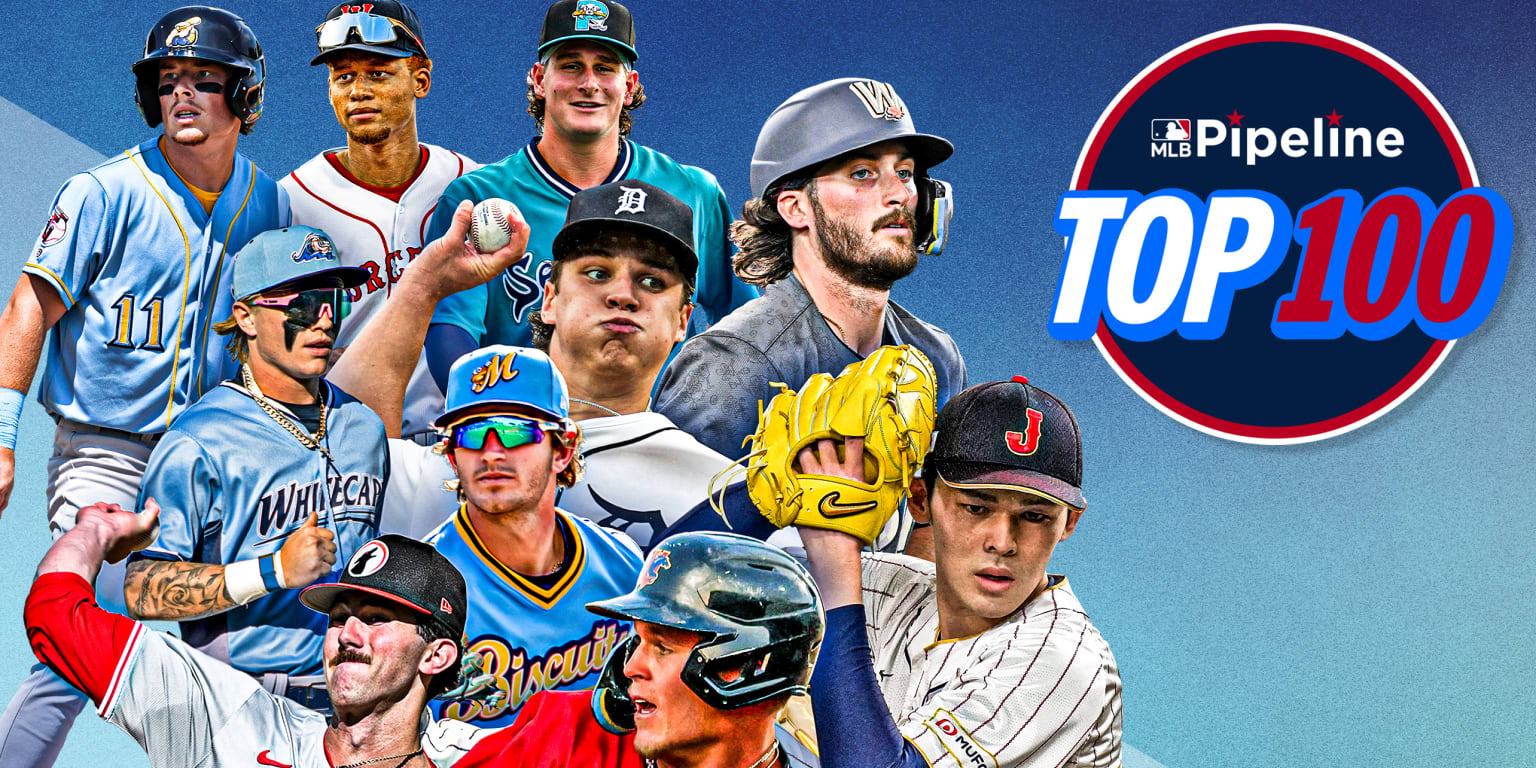
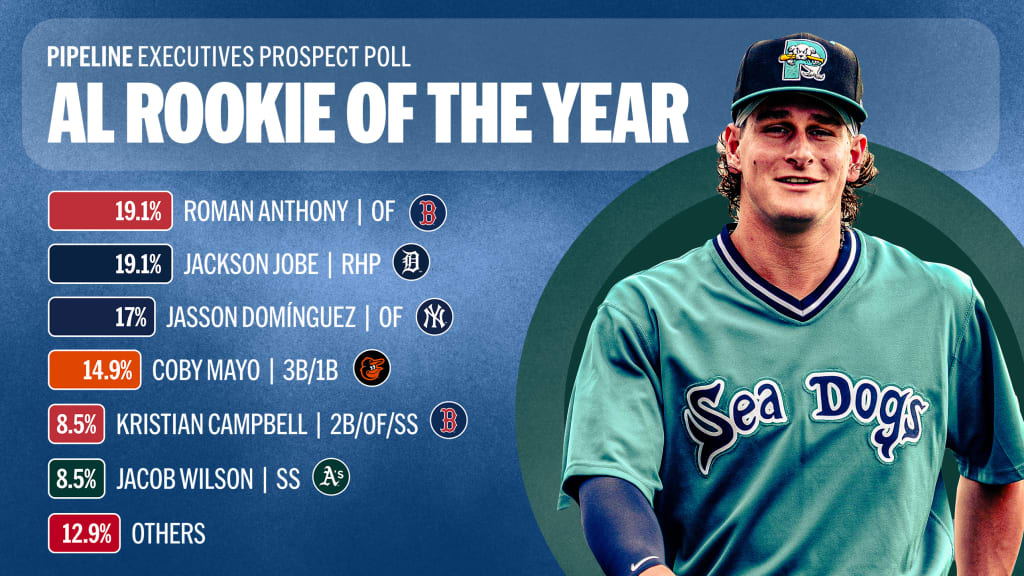
While the 2024 National League Rookie of the Year race was the more entertaining between the two leagues, 2025 brings a fresh breath of talent to the American League. Each of the players below are the top prospects for their respective clubs with two of the prospects likely to make the opening day rosters.
Favorites
Jackson Jobe
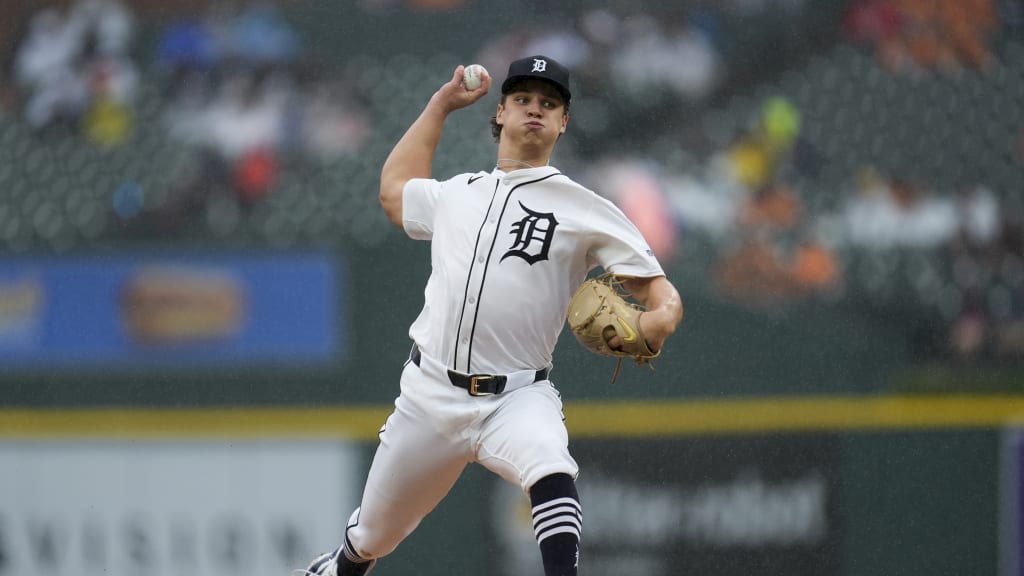
The Tigers made an exciting playoff run at the end of last season. After trading Jack Flaherty and continuing to sell at the trade deadline the Tigers appeared to be giving up on the season. However, after the deadline the Tigers caught lightning in a bottle and made it into the postseason. As a wild card team, the Tigers took the Guardians to five games in the Divisional Series. During that stretch the Tigers were short on pitchers and called up their top pitching prospect Jackson Jobe. Jobe threw four innings during the regular season in two games and finished with a 0.00 E.R.A.
From a scouting standpoint Jobe recently struck out perennial All-Star Vladimir Guerrero Jr. in a spring training start, displaying his dominant pitching arsenal. Jobe’s best pitch is his fastball that sits in the upper 90s with excellent rise. Jobe then pairs his fastball with another plus pitch in his slider. His slider is an analytics darling thanks to its high RPM and movement. Jobe additionally, throws a changeup and cutter to complete his pitching arsenal. The biggest gripe against Jobe is his workload and injury history. He set a professional career high last season throwing 91 ⅔ innings across multiple levels. Additionally, he missed time due to a strained hamstring and back inflammation over his early career.
Jacob Wilson
Jacob Wilson is one of the best pure hitting prospects in recent history. He has the swing and hands to adapt to any pitch in any zone. Not to mention he strikes out in fewer than 10% of his plate appearances. That is unheard of in today’s game. His approach is comparable to hitters from the 60s and 70s. He is in the box to put the ball in play and will do so on a line. He will swing at anything and make contact. In my opinion Jacob Wilson will win a batting title at some point during his career.
Wilson is also the son of a former gold glove shortstop, Jack Wilson (Pirates, Mariners, and Braves), and it’s apparent in his game. Jacob Wilson profiles to be a potential gold glove shortstop thanks to his soft hands and excellent footwork. If it is within his range he will cleanly field the ball and deliver a strike to first.
If he has a weakness, Wilson lacks the ability to hit for power. He will likely never hit more than 15 home runs in a season and he doesn’t have elite exit velocity numbers. This can be concerning in today’s MLB where every hitter chases launch angle and exit velocity. Additionally, Wilson is of average speed. For someone who is a contact hitter with little power, speed is normally a must. Wilson is by no means slow but he’s not going to impress on the base paths.
Dark Horse
Travis Bazanna
Travis Bazanna was the number one overall pick and the only one of these prospects I’ve had the opportunity to see in person. Bazanna was the obvious choice at number one for the Guardians last year. He has the potential to have an elite hit tool and also be an above average power hitter for his position, second base. This is all in large part due to his quick hands and compact swing from the left side. While he struggled at first, Bazanna helped lead the Lake County Captains to their first Midwest League Title in 14 years; he homered for his first professional hit. His numbers, while not impressive, were brought down by how long it took him to get adjusted. There is no doubt in my mind however that Bazanna will hit at the next level.
Now the red flag for the Guardians taking Bazanna at number one overall was the fact that he is and only will be a second baseman. Bazanna is athletic but not a great fielder. His athletic ability lets him cover more area than most but he lacks the fundamentals at the position and is regularly caught in between hops. Additionally, Bazanna’s arm keeps him regulated to second base long term with a below average grade.
The Guardians made a move this off season to free up second base for Bazanna at the position. In December the Guardians traded their gold glove second baseman, Andrés Gimenez, for a starting pitcher, two pitching prospects, and an outfield prospect. This trade was only two seasons removed from a 7 year extension with the Guardians for Gimenez. Making a move like this hints at the faith that the Guardians have in Travis Bazanna and his future. However, Bazanna has only played in High-A for the Guardians last season. While he will likely start the season in Double-A the Guardians are not likely to be rushing him to make his MLB debut.
Conclusion
Jackson Jobe looks like he could be this season’s Paul Skenes. Jobe has a great pitching arsenal led by an elite fastball similar to Skenes. Additionally, Jobe already has had the experience in high leverage situations at the Major League level pitching for the Tigers in relief during last year’s postseason. His AL Central counterpart, Travis Bazanna is a former number one overall pick with a ton of potential in front of him. The Guardians have freed up second base for the long-term for Bazanna to take over and it’s just a matter of time for him to do so. Out west Jacob Wilson is coming to the league as one of the most disciplined hitting prospects in recent history. The only thing holding him back will be his power, but he benefits from playing a critical position at shortstop. This race is likely to be as good as the fans have seen in recent memory.
Brady Shick is a recent graduate of Bowling Green State University from Sagamore Hills, Ohio. He is currently pursuing a career in Baseball Operations and looking for opportunities.
Twenty twenty-four brought one of the best National League (NL) “Rookie of the Year” Races in recent years. Headlined by two first round picks in Paul Skenes and Jackson Merrill, it was one of the tightest races we have seen. Even the third finalist, Jackson Chourio, would have been likely to win Rookie of the Year most other seasons. Chourio finished the season batting .275 with 21 home runs and 22 steals. Meanwhile, Merrill’s efforts in batting .292 with 24 homers resulted in him earning his first ‘Silver Slugger’ award. FInally, Skenes finished the season as a NL Cy Young Candidate with a resume of 133 innings pitched, a sub 2.00 ERA, and 11 wins. Skenes ended up taking home the award in a tight race with Merrill and this season could bring the same.
2025 Favorites
Roki Sasaki
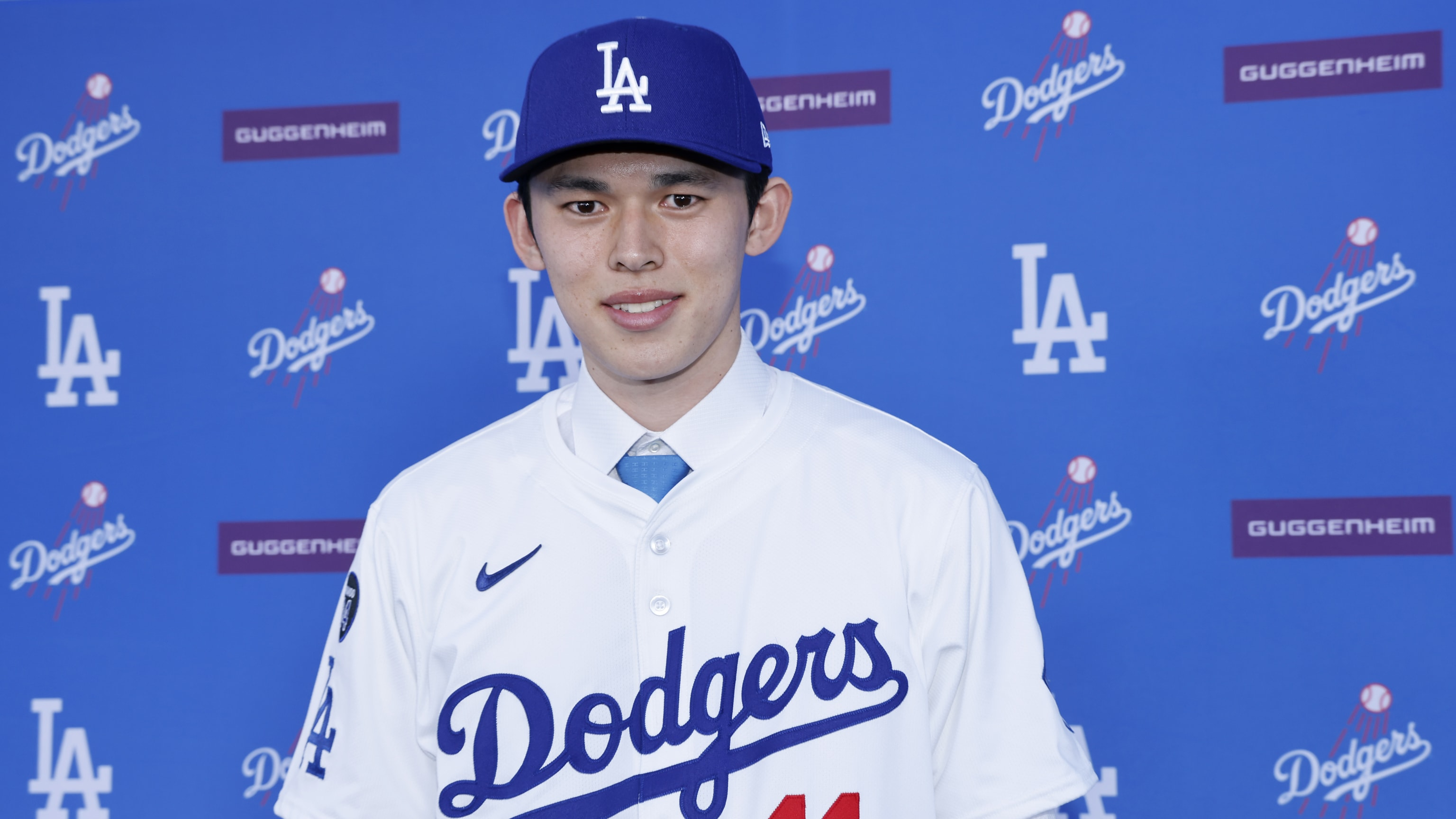
Right now far and away the favorite for NL Rookie of the Year is Roki Sasaki. Sasaki comes over from Nippon Baseball in Japan to join the reigning World Series winning Los Angeles Dodgers. Sasaki was one of the biggest free agents this season aside from Juan Soto. In Japan’s professional league, Sasaki had a 2.10 E.R.A over 4 seasons, and more than 500 strikeouts in fewer than 400 innings. While in Japan, Sasaki also outdueled Yoshinobu Yamamoto in a head-to-head matchup before Yamamoto signed his 12-year $325 million contract with the Dodgers last offseason. Sasaki also dominated during the World Baseball Classic (WBC) with two spectacular starts in 2023.
The only thing stronger than Sasaki’s reputation is his pitching arsenal. Sasaki debuted his stuff for the world at the WBC with a fastball consistently topping out at 100+ and an elite splitter. These pitches led to 11 strikeouts on two starts for Sasaki including some against current MLB veterans.
Sasaki goes into one of the best situations possible in LA. Joining an organization known for developing talent, especially on the pitcher’s mound, with names like Clayton Kershaw, Walker Buehler, and Ross Stripling, they are poised to help Sasaki fulfill his potential. This along with being one of the best pitchers in Japan is why Roki Sasaki is the current favorite to win National League Rookie of the Year.
Dylan Crews
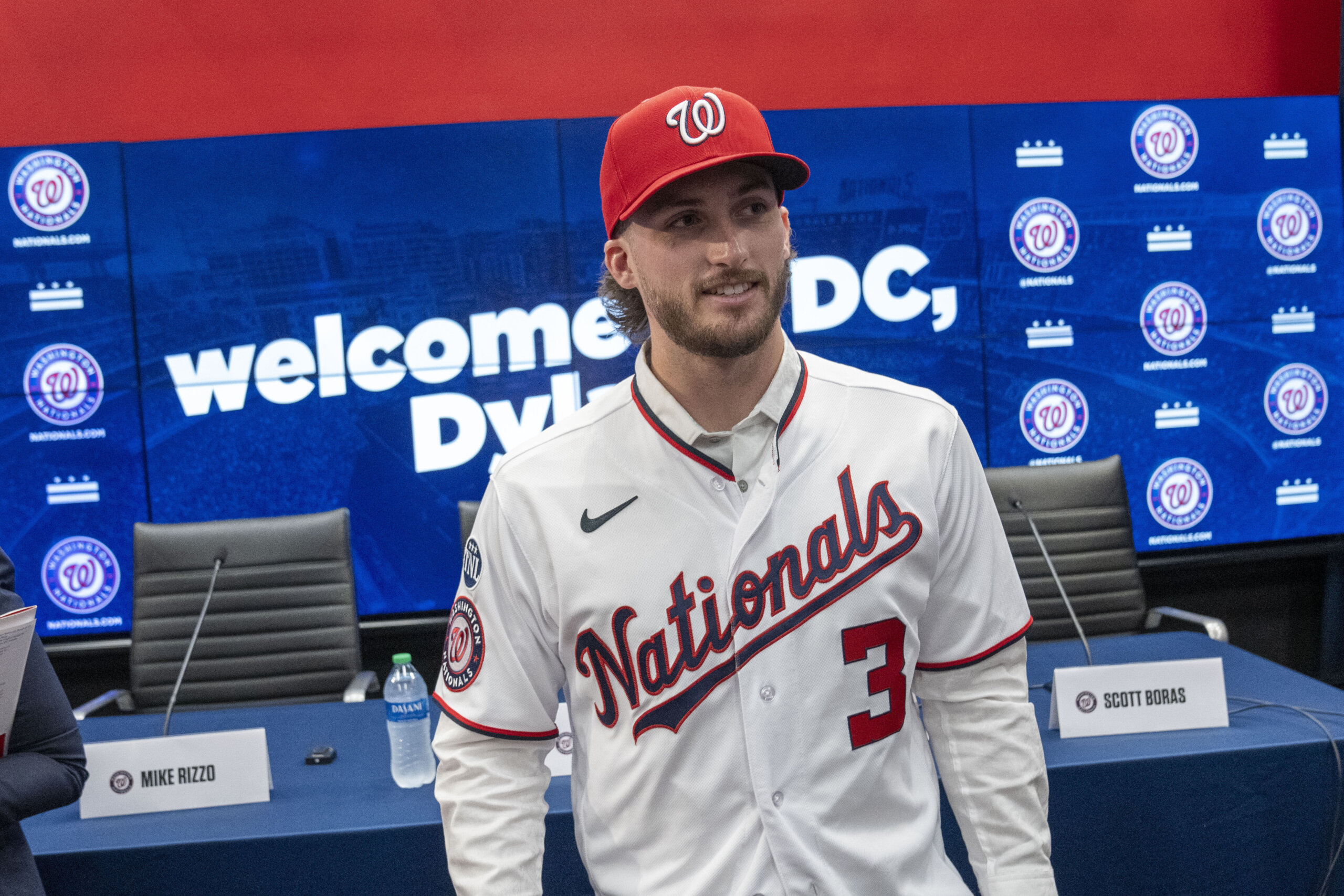
Even though Paul Skenes finished his first season in the majors as a Cy Young finalist and National League Rookie of the Year, the media wasn’t sure if he was going to the Pirates with the first pick. There was buzz around his Louisiana State University teammate outfielder Dylan Crews that he might be going to Pittsburgh. Crews was a five-tool prospect coming out of college and had a dominant junior year batting over .400 with 18 home runs. However, Crews ultimately ended up being drafted by the Nationals who held the next pick.
Crews made his Major League Debut in 2024, but still maintained his prospect status thanks to a small sample size of at-bats and he is ranked as the 6th best prospect by Baseball America. While Crews did not have a great start to his career he showed flashes of his five tool potential. Crews stole 12 bases in 31 games, played well defensively, and added 8 extra-base hits. Crews will make the Nationals’ roster out of Spring Training to be an everyday outfielder for the Nats. He will be a strong contender for Rookie of the Year.
Bubba Chandler
In high school Bubba Chandler was a multi-sport athlete. Prior to being drafted he was a 4-star quarterback recruit committed to play at Clemson. However, when he was drafted by the Pirates in 2021 he decided to sign with the franchise and start his professional baseball career. Originally, Chandler was a two-way player for the Pirates’ affiliates, where he would play in the designated hitter spot on days he wasn’t pitching.
Last season saw Chandler’s first year in the minors where he devoted himself strictly to pitching. This decision saw a vast improvement in his season statistics from a year prior and he really excelled in Triple-A for Indianapolis. Chandler saw his best minor league success late in the season last year just one step away from Major League Baseball. In Triple-A Chandler finished the season with an E.R.A of 1.83 in nearly 40 innings with 54 strikeouts in 7 starts.
The main thing holding Chandler back amongst this group is the timetable for his MLB debut. The Pirates are notorious for manipulating service time to get the most years of control for their top prospect using the Super-2 deadline. This deadline is an arbitrary date during each season in which a player doesn’t receive a full year of service time. This gives the team an extra year of control before the player goes to free agency. The Pirates have done this for almost all of their top prospects including Paul Skenes, Gerrit Cole, Andrew McCutchen and other top prospects. Additionally, the Pirates are not contenders so there is no reason to push Chandler to Pittsburgh.
Conclusion
The favorite to win National League Rookie of the Year is undoubtedly Roki Sasaki. From his stellar performances at the World Baseball Classic and dominating in Japan, Sasaki has debuted his talent across the world and it’s time for him to showcase it for Major League audiences. Dylan Crews and his five tools will be an immense talent for a young Nationals team with no one to take away opportunities. It will be time for him to show more than just flashes of his five-tool potential. As for Chandler the only thing holding him back is the Pirates’ timetable for his debut. Regardless, this year’s race could be just as exciting as the 2024 Rookie of the Year race.
Lily Smith is a second-year undergraduate at BGSU from Oregon, Ohio. She is majoring in Sport Management with a Marketing minor. In her spare time, she is an intern in the BGSU Athletics Marketing department, a BGSU Campus Tour Guide, and an avid reader. She is passionate about all things women’s sports, and all things women in sports.
Coming up in just a few short days, I will be departing for New Orleans. I am going with the BGSU Sport Management Alliance, the pre-professional group for Sport Management majors to volunteer and work experiences in and around Super Bowl LIX. I am beyond excited for this opportunity, as this is not something just everyone gets to experience.
Growing up, I have always been fully immersed in the NFL. Every year, for about 45 years, my family hosts a Super Bowl party. Hosting has been passed down and moved around, but the tradition still remains. These days, the party is hosted at my parent’s house, and is the biggest event of the year for my family. We usually order pizza, drink a lot of pop, and of course, the biggest tradition, the Super Bowl cakes.
I have no idea when this tradition started, but it has been going on for as long as I can remember. We go over to my Grandma Deb’s house, and my dad, sometimes my Uncle Brian, and sometimes my other cousins, and I decorate these helmet shaped cakes based on the two teams competing that year.
Grandma Deb, myself, and my dad in 2022.
I am sad to miss out on these traditions, but I know I will be gaining experience during the trip. We have so much planned and so many fun things to do. I have never been to Louisiana before, so I am so excited about our trip to New Orleans and the surrounding areas. My family is disappointed that I will not be there for our party, but they know that this is something that I may never get to experience again.
Over the next few weeks, I will be sharing my experiences and lots and lots of pictures. I will be using Maxwell Media Watch almost like a travel blog or diary for my Super Bowl LIX experience.
Alexis Shuttleworth is a freshman Sport Management major. Her main interests are in College and Professional Football, Hockey, and Motorsports.
January 1, 2025
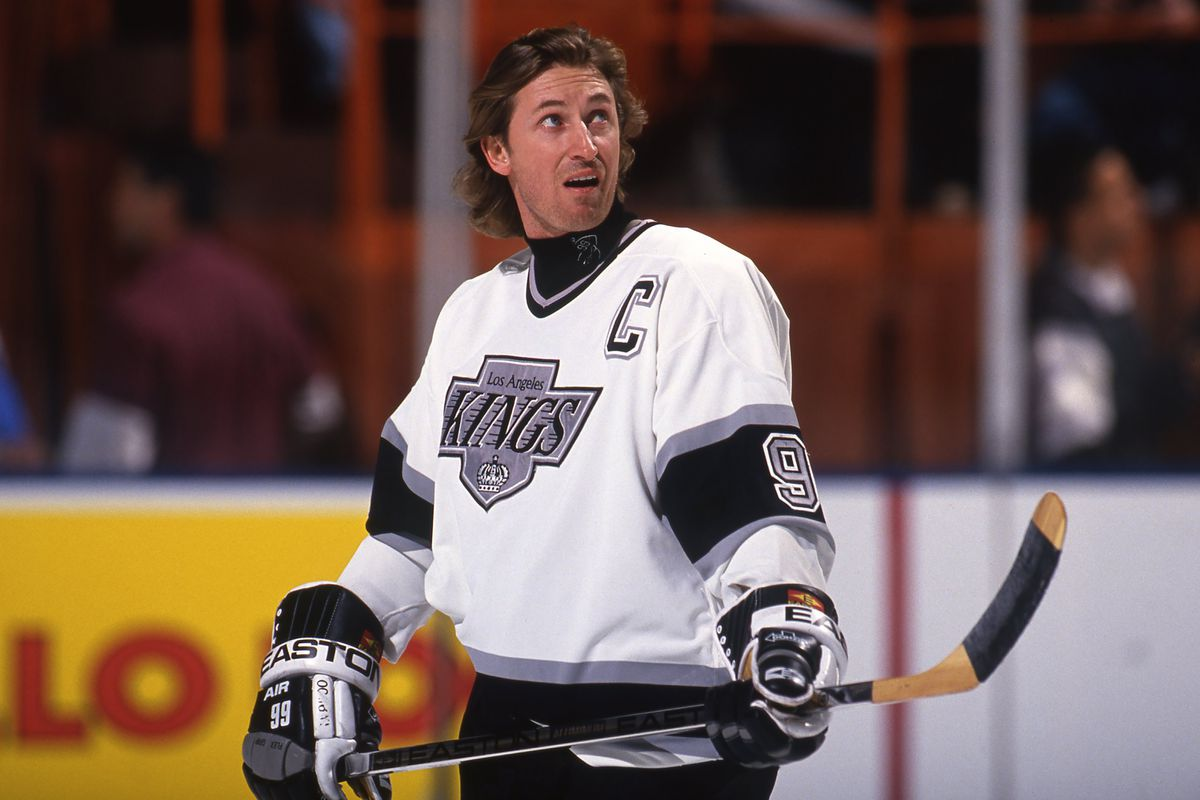
What does it take to be called “The Great One”? For Wayne Gretzky, it meant not only shattering records but also transforming hockey and leaving an indelible mark on the world of sports. Wayne Gretzky is a Canadian-born hockey player who is widely considered the greatest player in the history of the sport. Many even argue that he is one of the best athletes of all time. With such fame and popularity, he has impacted others, including fellow players, teams, coaches, aspiring hockey players, and the sport as a whole. Gretzky’s remarkable achievements on the ice, his impact on the NHL’s growth, and his role as a positive role model for athletes have solidified his status as one of the most influential figures in sports history.
What makes a person influential? What defines a pop icon? There isn’t a straightforward answer to these questions; it often depends on individual interpretation. I want to break it down into five different categories: 1. star power and/or talent, 2. personality, 3. the ability to break social norms and 4. showmanship, and 5. the impact an individual leaves behind. Although Wayne Gretzky is neither a pop star nor an award-winning actor, I believe he embodies all the qualities necessary to be considered a pop icon. Not only is he a pop icon, but he is also someone that people look up to which I believe is the most important aspect of being a famous sports player and is the proper way to use your fame. As Gretzky himself explains, “behind every big play, there’s another guy who grew up dreaming of making that play. He’s got a story, and he was inspired by someone else’s story” (Gretzky & McClellan Day, 2016, p. ix). The beauty of being a popular icon in sports is inspiring the ones after them to be just as great, or even greater.
Wayne Douglas Gretzky was born on January 26th, 1961, In Brantford Ontario, Canada. His deep love for hockey sprouted from his father Walter Gretzky who is often referred to as “Canada’s Hockey Dad”. Walter had even built a skating rink in the family backyard and named it “Wally’s Coliseum”. This is the place where Wayne would spend countless hours perfecting his craft. It was known at a young age Wayne would be something great. As Felix writes on International Hockey Net, “by the age of 5, Wayne was already demonstrating remarkable prowess on the ice, skating circles around older kids and displaying uncanny ability to handle the puck with finesse” (para. 4). Felix writes that in the early years what set Wayne apart from the rest was not just his skill but his dedication to the game. This is something that would follow him into his later years of life as well.
Before exploring Wayne Gretzky’s career and how he became a popular household name, it is important to understand the factors that contribute to him achieving greatness in this sport. To grasp how an average kid from Brantford, Canada, transformed into a well-known figure celebrated for his remarkable accomplishments and dedication to hockey, we must first examine his upbringing. The young Gretzky had an icon whom he always admired – i.e., Gordie Howe, and he is not shy to make it known that Howe was the reason he started his career in hockey. Even the iconic number he wore, 99 (The only number retired across the NHL) (Jackson, 2000), is due to Howe. “It’s special not because I wore it. It’s special because someone who came before me wore the number 9. All I wanted to be when I was growing up was Gordie Howe.” (Gretzky & McClellan, 2016, p. xiv). Gretzky transformed from being a 6-year-old boy learning the sport of hockey from his dad, inspired by a dream of becoming like the great Gordie Howe, to ultimately being recognized as the greatest player ever to step onto the ice. Having role models in life is one of the most important aspects of sports and is how many of the “Greats,” as we know them, are as good as they are.
Wayne Gretzky stands out among the hockey legends primarily because of the remarkable records he set in the NHL and his dominance. “He is simply, ‘The Great One,’ a player of unsurpassed skills who dominated hockey as no other single player has ever dominated a team sport” (Hickok, 1995, p. 305). Even 25 years after his retirement in 1999, he still holds most of these records. During his career, Gretzky set a total of 61 records, and as of today, he retains 57 of them (Jackson, 2000). Instead of listing all the records, which could possibly exceed my page limit, I will highlight some key records that truly illustrate Gretzky’s dominance as a player.
In the regular NHL season, players earn points by scoring goals or providing assists to other players’ goals. Gretzky still holds the record for the most points scored in a single season. Incredibly, he also ranks 2nd, 3rd, 4th, 5th, 6th, 7th, 8th, 9th, and 10th places for this record, meaning he has beaten his own record a total of ten times. Also, there is a 54-point difference between Gretzky, in first place, and Mario Lemieux, who is in 11th place. There have also been three players in NHL history to have 100+ assists in a single season: Mario Lemieux (1 time), Bobby Orr (1 time), and Wayne Gretzky who did it in 11 consecutive seasons. This demonstrates just how exceptional Wayne Gretzky truly was during his time on the ice. There are many different aspects that contribute to being an influential figure, especially in the field of sports, and excelling in sports is just one of those aspects.
An often-overlooked factor in the realm of sports pop icons is their personality outside of their fame. While impressive statistics in the league are important, they lose significance if an athlete is perceived in a negative light off the field. Such individuals may be labeled as “privileged” or “changed by fame.” This perception can influence how younger audiences look up to these athletes. For instance, parents may be reluctant for their children to look up to someone like Deshaun Watson, despite his football prowess, due to his negative actions and off-field image.
In contrast, Wayne Gretzky exemplifies admirable behavior both on and off the ice. He is widely regarded as one of the kindest and humblest athletes in history. To prepare for this essay, I read his autobiography, 99 Stories of The Game (Gretzky & McClellan Day, 2016), which provided deeper insights into his thoughts and mindset after retirement. Interestingly, I found that the book focused more on his teammates and coaches than on Gretzky’s own NHL career, highlighting the type of person he is. He believes that the stories generated throughout a player’s journey are what truly define them and shape the NHL, rather than statistics or wins and losses. As Gretzky states, “The fact is greatness is not captured in statistics. It’s captured in stories” (Gretzky & McClellan Day, 2016, p. xi). He further explains, “Without these stories, I would not have been the player I was, and the NHL wouldn’t be the league it is today” (Gretzky & McClellan Day, 2016, p. xiv). This perspective is essential for a true sports icon.
In the book Outtakes: Dan Patrick, American sportscaster and radio personality Dan Patrick interviews Gretzky. He shares that Gretzky expressed a desire not to be number one on the SportsCentury list, saying he simply didn’t want the pressure and attention. Instead, Gretzky preferred to be ranked second, fourth, or ninth. He said he would be fine with being recognized as the second-best athlete of the century or being in the top five or ten. He was comfortable knowing his place was near the top but didn’t want to occupy the top spot. It is hard to argue with that sentiment (Patrick & Sampras, 2000). Few athletes share such a perspective, as, for many, being number one is the goal. For Gretzky, however, the priority was to play the game he loved and inspire others to do the same.
Wayne Gretzky exemplifies what it means to be a popular icon, due to his ability to break social norms in hockey and embrace showmanship during his playing career. To achieve true popularity, one must endure and stand out. If you are an average hockey player stuck on the fourth line with a few points, your name is unlikely to be remembered. In contrast, Gretzky possessed exceptional talent and skill that will be talked about for generations to come.
The final and, in my opinion, most crucial aspect of being a beloved public figure is the impact you leave behind. Many pop icons that come to mind are still being discussed today because of the influence they had on their communities. For instance, Elvis Presley has been gone for 47 years, yet he is still regularly mentioned with great admiration and continues to be a household name. Why is that? It’s because of the significant impact he has had on the music scene. He is often referred to as the “King of Rock and Roll.” The influence individuals have on their communities is what keeps their legacies alive for many years to come.
Wayne Gretzky exemplifies greatness in numerous ways, especially through his impressive records and statistics. Although he last played in the NHL in 1999, he still holds an astounding 57 records. It’s likely that many of these records will remain unbroken for years to come, and some may continue long after he has passed away. Gretzky’s name will persist in record books and graphics for many years, ensuring that his legacy will be prominent in the NHL for generations.
Not only did he have an impact on the hockey world he also had an impact globally and he illuminated Canada’s identity crisis at one point. For example, Steve Jackson (2000) reflected “upon the 1988 crisis of Canadian identity by tracing the discourses that linked the fate of one sports star, Wayne Gretzky, to the fate of the nation within the context of an impending threat of ‘“’Americanization’” (p. 166). When Gretzky was traded from the Edmonton Oilers in Canada to the Los Angeles Kings in America it was articulated as a crisis in Canadian identity. Many believed this would ruin the star’s fame and that he would no longer be considered a “Canadian Star.” This did not happen, however. It proves though how much of a popular figure Wayne Gretzky was at the time to cause this much discourse between countries.
One final reason, among many, that Wayne Gretzky impacted the sport of hockey is through his influence on how the game is played and his ability to inspire a new generation of hockey players. It is well-known that many athletes admired Wayne Gretzky while growing up. He transformed the public’s perception of the sport and motivated numerous players currently in the NHL to pursue their dreams.
While many may have differing opinions on what defines a popular icon and who deserves that title, I will always view Wayne Gretzky as the perfect figure who embodies the essence of hockey. He exemplifies this through his remarkable dominance on the ice, his incredible personality, the transformative changes he brought to sport, and, most importantly, the lasting impact he has made. Gretzky is the reason for my passion for hockey, and I know that many others share this same feeling as well. His legacy will continue to thrive as long the sport of hockey is played, and this is what makes him a pop icon.
Gretzky, W. & McClellan Day, K. (2016). 99: Stories of the Game. New York, NY: Penguin.
Hickok, R. (1995). A Who’s Who of Sports Champions. Boston, MA: Houghton Mifflin.
Jackson, S.J. (2000). Gretzky nation: Canada, crisis, and Americanization. In D.L. Andrews, & S.J. Jackson (Eds.). Sport Stars: The cultural politics of sporting celebrity (pp. 164-186). New York, NY: Routledge.
Patrick, D, & Sampras, P. (2000). Outtakes: Dan Patrick. New York, NY: ESPN Books.
Vincent Briedis has been the Assistant Athletics Director of Strategic Communications since July 2021. A member of the senior staff, Briedis is the primary spokesperson for BGSU Athletics and is the primary media contact for football and gymnastics.
Thanks to Vincent for permission to post this article on Maxwell Media Watch.
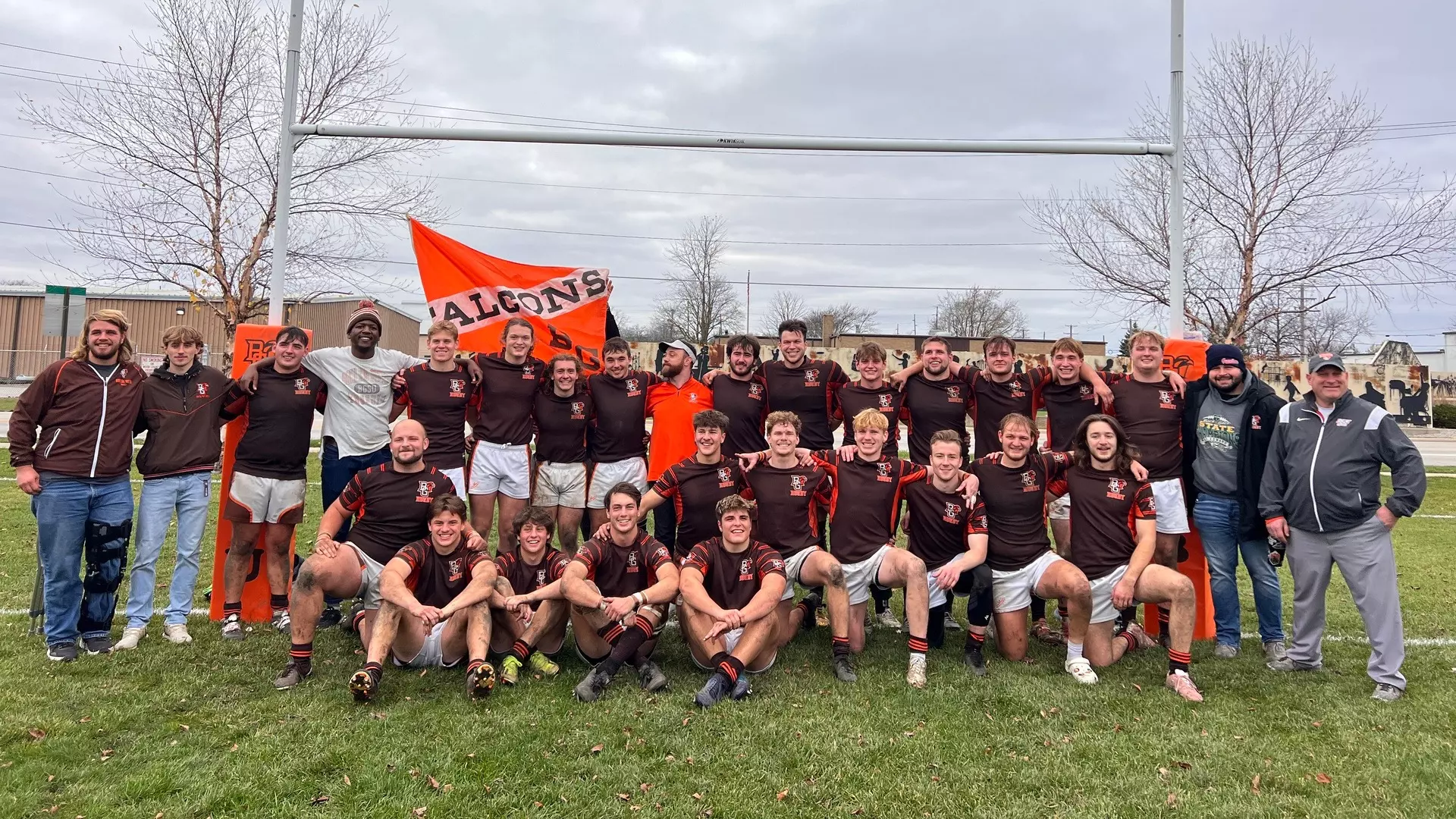
BOWLING GREEN, Ohio – The Bowling Green State University (BGSU) club men’s rugby team is on the cusp of glory, preparing to face the University of Kentucky in the Division I-AA National Championship. The match is set for 3 p.m. ET on Saturday at SaberCats Stadium in Houston, Texas. Fans can watch the action live via subscription on The Rugby Network.
The championship game features the top two teams in the NCR Division I-AA rankings: the undefeated No. 1 Kentucky Wildcats and the No. 2 Bowling Green Falcons. Both programs enter the match as conference champions, with Kentucky reigning in the Southern Collegiate Rugby Conference (SCRC) and BGSU reclaiming dominance in the Mid-American Conference (MAC).
Kentucky, the defending national champion, has been strong this season, boasting an 11-0-2 record. The Wildcats captured their second consecutive SCRC title and are seeking back-to-back national championships, having won the 2023 crown in commanding fashion over Louisville. BGSU is looking for its second-ever national title and first since 2018.
The Falcons, meanwhile, bring a 12-1 record to the final, fueled by a season of physical play and clutch performances. The team’s recent victories over Clemson (29-18) and Virginia Tech (20-18) in the Collegiate Rugby Championship Quarterfinal and Semifinal rounds demonstrated their ability to win under pressure.
A Battle of Styles The matchup promises to be a fierce contest between two well-rounded teams. BGSU’s forward pack, led by senior No. 8 Phil Tracey, is a key strength, with the Falcons excelling in the scrum and lineout. Kentucky’s balanced attack and championship pedigree, however, present a formidable challenge.
For Bowling Green, the path to Houston has been paved with resilience and thrilling finishes. After overcoming a 20-point deficit to beat Louisville 34-33 for the MAC title, the Falcons edged Virginia Tech with a dramatic 20-18 victory to secure their spot in the championship game.
Kentucky, on the other hand, has cruised through its schedule, relying on a blend of skill and discipline. As reigning champions, they are no strangers to the pressure of high-stakes rugby.
A Legacy of Excellence Both teams carry rich traditions into the championship. Kentucky’s recent dominance underscores its rise as a national power, while Bowling Green boasts one of the longest championship-winning streaks in collegiate athletics, with 42 MAC titles since 1982 and a national championship in 2018. Fans can expect 80 minutes of hard-hitting rugby as these top programs vie for the national title. Whether it’s Kentucky seeking to repeat or Bowling Green aiming to reclaim the crown, this championship clash is set to deliver a memorable finish to the season.
Fitzpatrick Metzger is from Lakewood, Ohio, and is a graduate student at BGSU completing a masters in Sport Administration. He has a passion for soccer, rugby and sport analytics. In his free time, he is on the BG Rugby team as a player, club secretary, and SID.
December 3, 2024
Falcons set to face Virginia Tech in NCR Nationals Semifinals
Bowling Green, Ohio – The Bowling Green Men’s Rugby Team (11-1, 6-0 MAC, 1-0 Nationals) beat Clemson (4-3, 2-0 SCRC East) in a 29-18 victory in the National Collegiate Rugby (NCR) National Semifinal. BG now faces Virginia Tech (8-0-1, 4-0-1 MARC) in Reading, Pennsylvania in the semifinals for the NCR Nationals Tournament on December 7th, at 3 pm, at Penn State’s Berks Stadium.
“A hard fought game. WE did a really good job of dominating the first ten-fifteen minutes and put them under pressure. We let them off the hook a little bit by some missed kicks, putting ourselves back under pressure and really just had to ride that out,” said Head Coach Tony Mazzarella. “Eventually we got ahead of them and held on to it. It just ended up being our day.”
Going into the match Clemson was unknown. BG knew the Tigers could hold their own against tough competition, as shown in their 8-7 SCRC final loss to the reigning D1-AA NCR Champions Kentucky. Bowling Green came out strong and got a grip on the game. The change in field locations due to the week’s weather proved to be an important decision in eliminating some of the environmental conditions. Ultimately, the Falcons held their own and downed the Tigers with the help of vice-captain and 8-Man Phil Tracey who had three tries for a hat-trick.
“I think the boys have been playing very well this whole season, especially through this postseason. I’ve really just tried to play my part and give the boys big carries to play off,” said vice-captain Phil Tracey. “As for the scoring aspect I’ve just been blessed by my team and the Lord to have the opportunities to put the ball in the try zone and I’ve done my best to capitalize on those opportunities.”
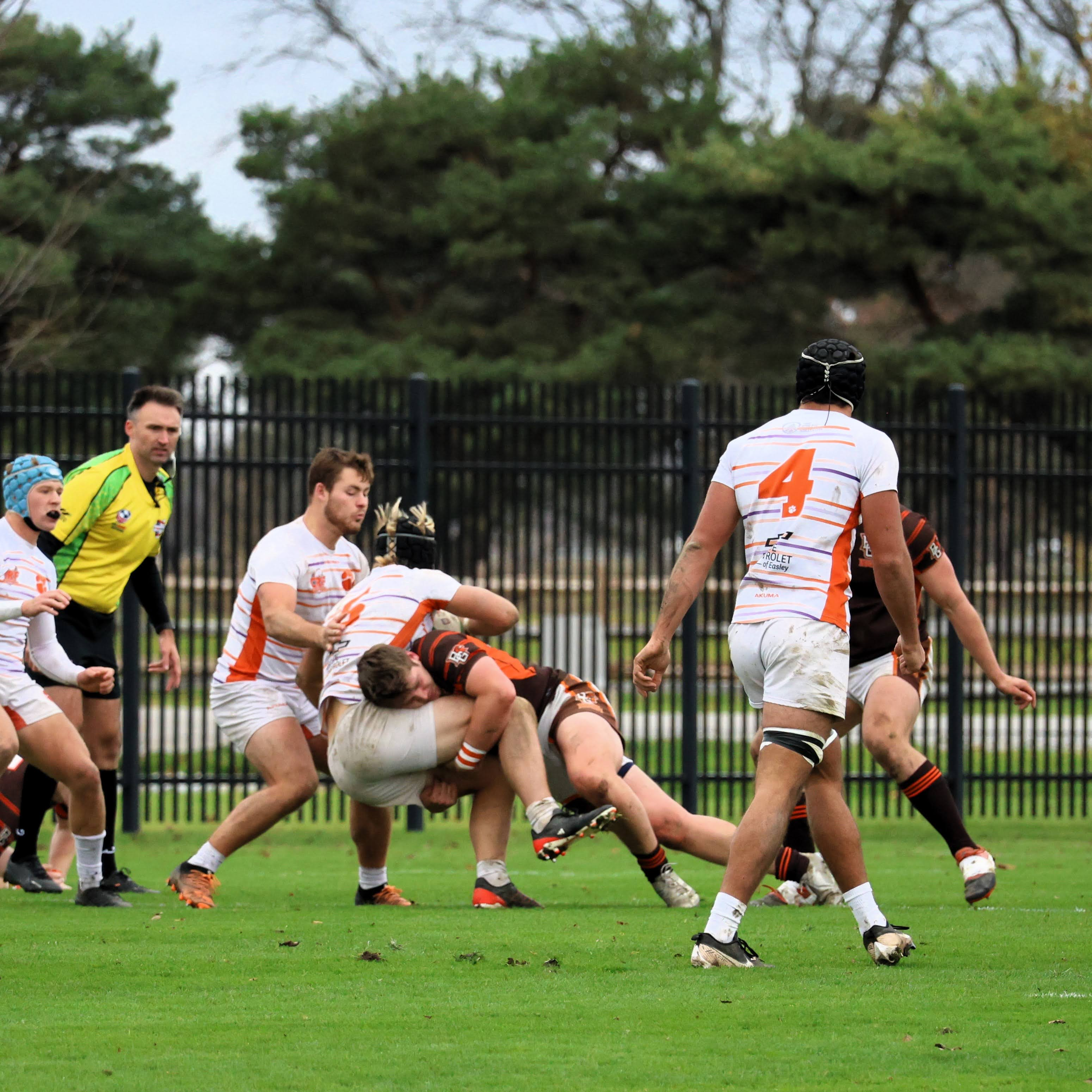
The Falcons kicked off to start the MAC Final. Once again, a beautiful kick from Captain Joey Apel allowed the Falcons to reclaim the ball instantly. The Falcons went on the attack, working all the way into Clemson 22 (i.e., the equivalent of the ‘red zone’). Although the Falcons didn’t score on the opening drive, they dominated the open 15 minutes of the game putting pressure on the Tigers. Vice-captain and 8-Man Phil Tracey broke the stalemate and gave the Falcons their first lead. Clemson soon drove down the field to score and convert for their first lead of the game. Phil would again give the Falcons the lead with his second try and Joey Apel converted. Clemson punched one back before halftime. In the second half, Clemson took the lead with a penalty kick. Phil scores again, completing his hat-trick and sparking a 17-point unanswered run by the Falcons. Prop Evan Holderer scored off a powerful run and Joey Apel converted his second of the game. Nico LaBianca scored his first of the match making it 29-13 going into the final minutes of the game. Clemson ended the Falcon’s 17 point scoring run with a try; however, it wasn’t enough to win the match. Overall, the Falcons played a solid match, doing well to manage Clemson’s kicking game. BG was able to advance through the NCR National Tournament Semifinal with a 29-18 win.
NOTABLES
Phil Tracey scores his seventh try in postseason: 3x Clemson (NCR Quarterfinal), 2x Cincinnati (MAC Semifinal) and Louisville (MAC Final)
Falcons return to the National semifinal
Bowling Green (11-1, 6-0 MAC) will continue into the post-season following the 29-18 win over Clemson with the semifinal of the NCR 15s National Tournament. The Falcons will face the 2021 and 2022 NCR National Champions and 2024 Mid-Atlantic Rugby Conference Champions Virginia Tech (8-0-1 Overall, 4-0-1 MARC) on Saturday, December 7th at 3 pm at Penn State’s Berks Stadium.
HOW IT HAPPENED
1st XV
Bowling Green 29, Clemson18
Kickoff
8-Man Phil Tracey opens the scoring (5-0)
Clemson scores and converts (5-7)
Tracey regains the Falcon’s lead with his second try (10-5)
Captain Joey Apel converts (12-5)
Clemson scores (12-10)
Halftime: (12-10)
Clemson scores a penalty kick (12-13)
Clemson misses a penalty kick (12-13)
Vice-captain Tracey scores his third of the game (17-13)
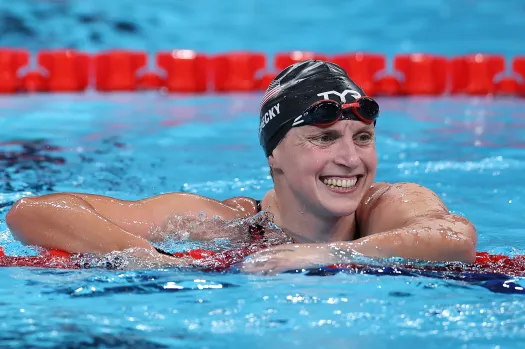
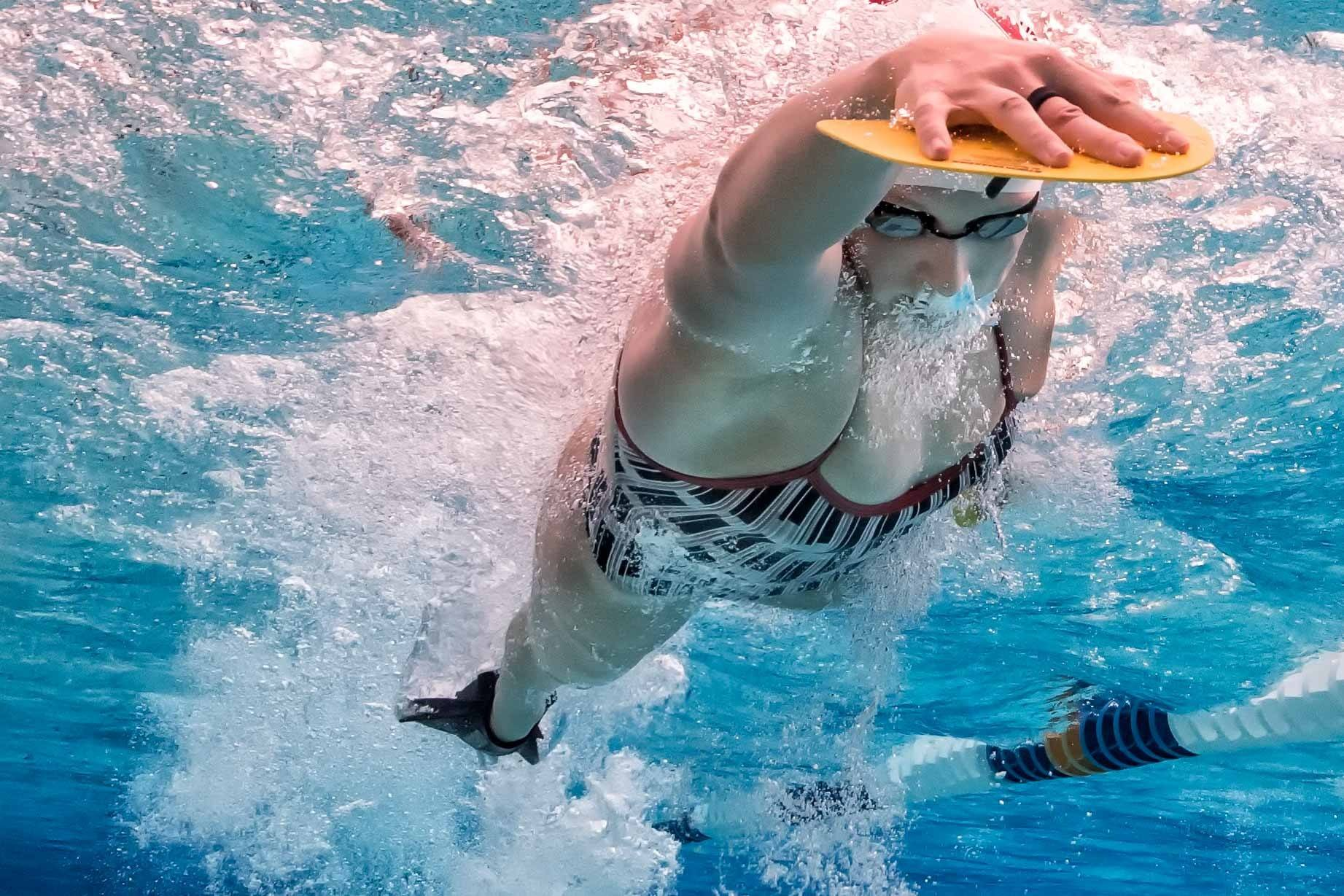
Caption: Katie Ledecky as she finishes her 1500 race in Paris
By Candice McNeill
Candice McNeill is a freshman marketing major and a member of the Marching band at BGSU. Her main interests are in college and professional football, baseball, and Olympic sports.
November 19, 2024
As the sun rises over Paris in 2024, all eyes are on Katie Ledecky, remembering her legacy as the greatest distance swimmer in Olympic history. Arriving in Paris, Katie Ledecky gets ready to dominate in her races. As time gets closer and closer to the last race, everyone notices that Katie Ledecky won gold in the 1500 and 800-meter races, she becomes the first-ever woman to win four consecutive gold medals in the 800-meter race. Starting with her 800-meter gold medal race in 2012 as only a 15-year-old, she became the youngest US Olympian to win a gold medal. As the Paris Olympics end, Katie still holds the world record in the 800 race at 8 minutes, 4.79 seconds and in the 1500 race at 15 minutes, 20.48 seconds. Her training and dedication have made her a formidable athlete with a track record of breaking and setting new benchmarks. Ledecky’s focus on both physical and mental preparation will be key as she approaches the competition, showcasing her unparalleled stamina and speed in the pool. Moreover, Ledecky’s impact extends beyond her impressive performances; she serves as a role model for aspiring athletes worldwide. Her sportsmanship, humility, and commitment to excellence resonate with fans and fellow competitors alike. As she competes in Paris, Ledecky embodies the spirit of the Olympics—pushing boundaries and inspiring others to pursue their dreams relentlessly. With her eyes set on new gold medals, she not only aims to dominate but also to leave a lasting legacy in the sport.
Setting records doesn’t come easy, but Katie Ledecky’s training regimen is meticulously crafted to prepare her for big races, blending endurance, strength, and mental resilience. Her daily workouts often exceed 20,000 yards (around 11 miles), combining long-distance swims with high-intensity training. This intense focus on endurance and speed allows her to build the stamina needed for her signature events, ensuring she can maintain peak performance throughout each race. In addition to her swimming workouts, Ledecky incorporates a comprehensive strength and conditioning program. This includes targeted weight training and core exercises designed to enhance her power and explosiveness in the water. By strengthening her muscles, she improves her swimming technique and minimizes the risk of injury, allowing her to train consistently at a high level. One of the biggest tips she said was she is not afraid to fail because sometimes that happens.
With her eyes set on future gold medals, she not only aims to dominate but also to leave a lasting legacy in the sport that transcends her achievements. Each stroke she takes in the water is a testament to years of dedication, countless hours of training, and the sacrifices she has made to reach the pinnacle of her sport. Ledecky’s journey is marked by both triumph and adversity, yet she approaches each competition with a fierce determination that encourages young athletes to believe in their potential.






 Maxwell Media Watch